
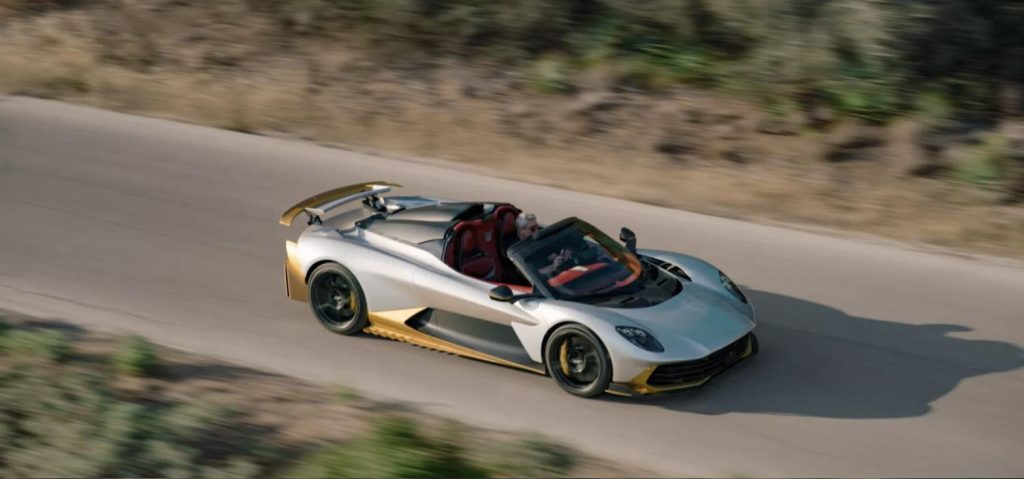
Aston Martin has taken the roof off the Valhalla. The Valhalla Spider was revealed on October 28, 2026, ahead of its public debut at the Concours at Wynn Las Vegas, and the headline is what it does not give up. It keeps the coupe’s full 1,079 PS (about 1,064 hp) plug-in hybrid powertrain and, according to Aston Martin, can still reach its 217 mph top speed with the roof removed. Customer deliveries are due to start in the third quarter of 2027.
What it is
Aston Martin calls the Spider its first mid-engined open-cockpit production supercar, and the fastest open-cockpit Aston Martin ever made. It arrives after the Valhalla Coupe, the company’s first mid-engined production supercar and its first plug-in hybrid, which launched earlier in 2026.
Underneath, the Spider uses a version of the coupe’s carbon fibre tub, developed with Aston Martin Performance Technologies, the consulting arm of the Aston Martin Aramco Formula 1 team. The company says the technical difference between the two cars is limited to revised active aerodynamics and stability control calibration, tuned to keep the car balanced with the roof on or off.
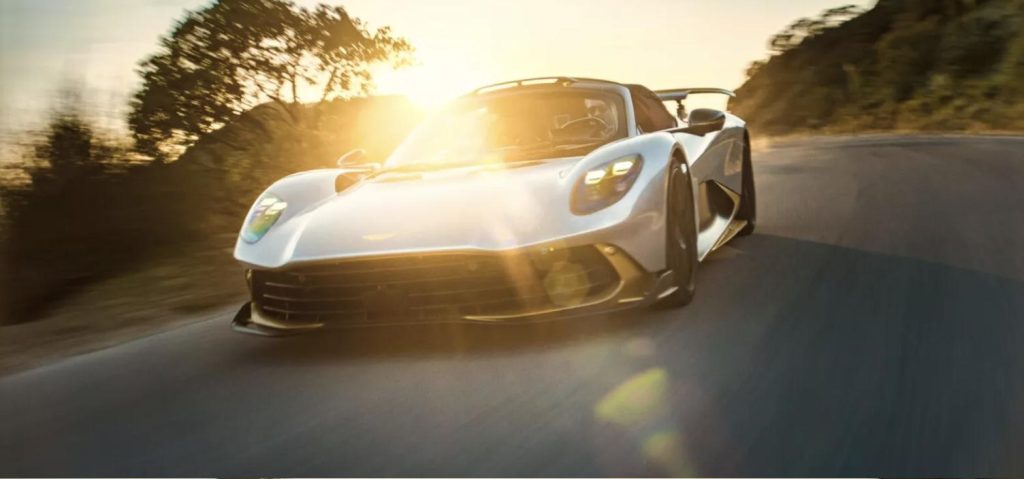
The powertrain is unchanged
The Spider shares the coupe’s powertrain. The core is a 4.0-liter twin-turbocharged V8 with a flat-plane crank, rated at 828 PS (about 817 hp). Aston Martin says its specific output of 207 bhp per liter is the highest of any combustion engine the company has built. Three electric motors add another 251 PS (about 247 hp), for a combined 1,079 PS (about 1,064 hp) and 1,100 Nm (about 811 lb-ft) of torque.
Two of the motors drive the front axle and provide torque vectoring. The third sits alongside the eight-speed dual-clutch gearbox and helps the V8 drive the rear wheels. Aston Martin says there is no mechanical connection between the front and rear axles, so drive to each wheel is managed electronically. Several outlets report that the car has no mechanical reverse gear and uses the front motors to reverse.
Aston Martin predicts a 0 to 62 mph time of about 2.5 seconds. Top Gear and The Drive report a 6.1 kWh battery, and The Drive cites about 8.7 miles of electric-only range. Those two figures come from the press coverage rather than Aston Martin’s release, so treat them as reported.
The roof is the whole story
Aston Martin describes a “comprehensive roof system” built around two options. A removable, stowable black fabric roof is listed as standard, and with it fitted the car is limited to 124 mph (200 km/h). An optional carbon fibre hard top allows unrestricted roof-on running up to the electronically limited 217 mph (350 km/h). A rain cover is supplied for static use.
The release marks the fabric roof as standard with an asterisk, and Automotive World reports that the carbon hard top is standard on cars sold in the US. The Drive adds that the fabric roof can be stored inside the car while the carbon hard top cannot. Rush and Elite Traveler both describe the roof as a manual, hand-fitted system rather than a folding mechanism.
With the roof off, a purpose-designed wind deflector clips into place. Aston Martin says it manages airflow off the windscreen header so cooling air is still pulled down to the engine snorkel while air is lifted over the occupants. With the roof on, the deflector folds into three pieces and stores in new 15-liter compartments in the sills. The snorkel itself has been reprofiled for the Spider and sits 35 mm taller.
What changed from the coupe
The aerodynamic and stability calibrations now adapt to both roof-on and roof-off conditions. Aston Martin quotes maximum downforce in excess of 600 kg (about 1,320 lb) with the roof fitted, and does not give a roof-off figure.
Inside, a new carbon fibre Touring Seat is standard, designed to make getting in and out easier with the roof on. The coupe’s original carbon seat can be kept at no cost for buyers who want more support. The dihedral doors are retained but are now frameless, with refined opening kinematics and a slightly more curved top edge to the glass.
Weight is not in the official release. One report puts the Spider at 1,680 kg dry with lightweight options, about 25 kg more than the coupe, but that is a single source and should be treated as unconfirmed.
Price, production and rivals
Aston Martin has not announced a price. Top Gear expects a starting price of around £1.3 million. For reference, The Drive lists the coupe at $1,051,700, and Elite Traveler puts it at £850,000 before options.
There is also no Spider-specific production number. The Valhalla Coupe was limited to 999 cars. Top Gear reports that Aston Martin expects about one in four Valhallas to be a Spider, and describes the car as “mostly” sold out, with most examples already allocated before the reveal.
The obvious rivals are the open-top versions of Ferrari’s and Lamborghini’s hybrid supercars. Rush lists the Ferrari 849 Testarossa Spider at £442,468, with 1,036 bhp, a 205 mph top speed and a folding hard top that stows in 14 seconds. The Valhalla Spider is expected to cost roughly two to three times as much, and it asks you to fit the roof yourself. What you get for that is a chassis and powertrain derived from Aston Martin’s F1 partner, and a top speed that does not drop when the roof comes off.
What we don’t know yet
Aston Martin has not published a price, a build number, an official weight or a roof-off downforce figure, and EU and rest-of-world homologation is reported to be pending. Nobody outside the company has driven the Spider, so claims about how it handles with the roof off are still the manufacturer’s. First deliveries in the third quarter of 2027 give plenty of time for all of that to change.
Specifications are based on Aston Martin’s official release of October 28, 2026, with additional details from Top Gear, The Drive, Automotive World, Rush and Elite Traveler where noted. We have not driven this car.